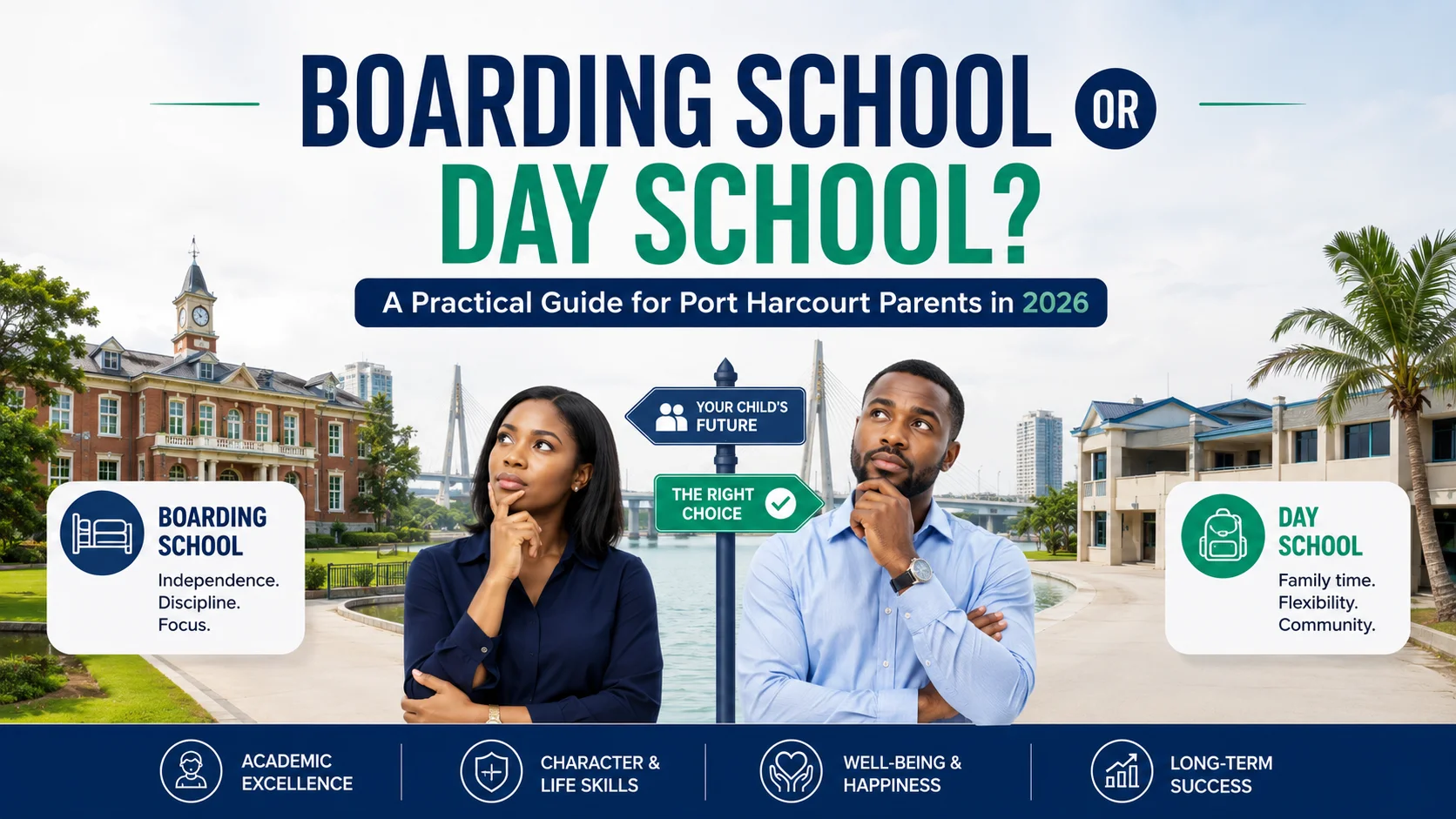
Walk into any PTA meeting in Port Harcourt, and the conversation will eventually turn to this. Boarding school or day school. Which one builds a better student? Which one is safer? Which one is worth the money?
Both sides have passionate defenders. Day school parents will tell you their children are more grounded, more connected to home, less likely to pick up bad habits from dormitory peers. Boarding school parents will tell you their children are more disciplined, more independent, better prepared for university, and less distracted by everything Lagos and Port Harcourt have to offer at 9 pm on a school night.
The truth, as usual, sits somewhere more specific than either argument. The right answer depends on your child, your family’s situation, and the quality of the specific school you are considering. This guide gives you the information you need to make that call.
What Does Boarding School in Nigeria Actually Look Like in 2026?
The mental image many parents carry around is the one they inherited from their own secondary school years: spartan dormitories, bad food, strict prefects, Sunday letters home. Some schools still look like that. The better ones do not.
At well-run boarding secondary schools in Port Harcourt, a student’s day begins with a structured morning routine: prayers, exercise, breakfast, and ends with supervised evening prep in a quiet study hall before lights-out. Meals are provided multiple times a day. Teachers are present on campus in the evenings, not just during class hours. Students cannot walk off to a friend’s house, cannot get lost in social media at midnight, and cannot skip prep because something interesting came on television.
At Jephthah Comprehensive Secondary School, for example, boarding students receive five meals a day: morning tea, breakfast, lunch, afternoon snacks, and supper, served in the school dining hall. There are separate male and female hostels managed by dedicated boarding house staff. Visiting days fall on the second Sunday of every month, which gives parents a regular, predictable opportunity to see their child without disrupting the school’s routine.
That structure is not incidental. It is the product.
The Academic Case for Boarding School
The most consistent advantage of boarding school over day school is not the teachers, the facilities, or the curriculum. It is the study environment.
A student doing homework at home competes for attention with siblings, neighbours, WhatsApp, the television, and whatever is happening in the house that evening. A student in a boarding school prep hall is in a room full of peers doing the same thing, supervised by staff, with nothing else competing for their attention.
Research conducted on secondary school students in South-Eastern Nigeria found no significant difference in the raw academic performance of boarding versus day students when family factors are controlled for. What the research also found is that the boarding school environment removes many of the family-level variables that drag day students’ results down such as absent parents, unstable households, or unreliable electricity for studying at home.
For families in Port Harcourt where both parents work demanding schedules and cannot consistently supervise homework or create structured study time, boarding school solves a practical problem that has nothing to do with the quality of teaching.
The Case for Day School
Day school is not a lesser option. For the right child and the right family, it is the better one.
Children who struggle with separation, who have genuine medical needs requiring close parental monitoring, or who thrive specifically because of their home environment do not need boarding school. Forcing an emotionally unprepared child into a dormitory at eleven years old creates a problem rather than solving one.
Day school also costs less. Not marginally, significantly less. The difference between boarding and day fees at most private secondary schools in Port Harcourt is substantial enough to fund a year of university preparation or private tutoring. Parents who are stretched financially and whose child has a stable, conducive home environment should weigh that honestly before paying for boarding.
There is also a developmental argument. Children who go home each evening maintain a consistent relationship with their parents through secondary school years. That connection, particularly during adolescence, matters in ways that are harder to measure than an exam result.
What the Evidence Actually Says
A 2023 study published in the Journal of Scientific Research and Reports examined 212 secondary school students in South-Eastern Nigeria: 123 boarding, 89 day. The mean academic performance for boarding students was 76.33% versus 76.51% for day students. No statistically significant difference.
What the study did find was that parental education and father’s occupation were the most significant family factors influencing academic performance in both groups. The boarding or day distinction mattered less than the quality of the home environment and the level of parental engagement.
The takeaway for Port Harcourt parents: boarding school does not automatically produce better results. A well-supported day student at a strong school will perform as well. What boarding school does is remove the ceiling that a challenging home environment places on a capable student.
Which Type of Child Thrives in Boarding School?
This question deserves an honest answer, not a sales pitch.
Children who tend to do well in boarding school share some common characteristics. They are reasonably self-sufficient emotionally. They make friends without great difficulty. They respond to structure rather than resisting it. They are old enough to manage basic personal organisation such as laundry, keeping their belongings in order, and keeping track of their schedule.
Most child development experts suggest that children under ten years old are generally not ready for full boarding. The recommended starting age for most Nigerian boarding schools is between ten and twelve, which corresponds to JSS1 entry. Even at that age, parents should have an honest conversation with the child before the decision is made.
Children who struggle with boarding tend to be those who have high separation anxiety, those who have been shielded from independence at home, and those who are already experiencing emotional difficulties. Boarding school intensifies what is already there, both strengths and struggles.
Questions to Ask Any Boarding School in Port Harcourt Before You Enrol
Before signing an admission form, visit the school physically and ask the following questions.
How are the dormitories supervised, and by whom?
Ask for names and qualifications, not just titles.
What is the ratio of boarding house staff to students?
There is no perfect number, but a ratio above one-to-thirty should prompt further questions.
What happens when a child is unwell at night?
Good boarding schools have on-site clinic staff, not just a nurse available during school hours.
How does the school communicate with parents during the term?
Can you reach your child? Can they reach you? Is there a structured communication protocol?
What does a visiting day look like, and how frequently does it happen?
Schools with visiting days only once a term or once a semester should explain why.
What is the school’s policy on bullying, and how has it been enforced in the last two years?
Any school that cannot give a specific, factual answer to this question has not enforced it.
What do students eat, and how many meals a day?
Ask to see a sample weekly menu, not just the brochure description.
Boarding School in Port Harcourt: What to Look For
Port Harcourt has a reasonable selection of boarding secondary schools ranging from well-resourced private institutions to less supervised environments that trade on reputation without maintaining it. The East-West Road corridor between Rumuokoro and the University of Port Harcourt has become a particularly active corridor for private schools, with several established institutions operating in that area.
When evaluating a boarding school in Rivers State specifically, pay attention to the following signals of a well-run institution: structured visiting days, named and identifiable boarding house staff, an on-site clinic with qualified nurses, supervised prep periods with teacher presence, a clear communication policy for parents, and a feeding arrangement that is transparent and monitored.
Jephthah Comprehensive Secondary School, located at Km4, East-West Road, Rumuome-Ozuoba, has operated a co-educational boarding programme since its founding in 1995. The school has separate male and female hostels, a clinic staffed by qualified nursing staff, five daily meals, and visiting days on the second Sunday of each month. Both boarding and day options are available, allowing families to choose the arrangement that suits their child.
The Short Answer
Boarding school works best for children who are emotionally ready, who benefit from a structured, distraction-free environment, and whose parents cannot consistently provide that environment at home. Day school works best for children with strong home support, those who need close parental proximity, and families where the financial trade-off of boarding fees is significant.
Neither is universally superior. The specific school, the specific child, and the specific family situation determine the answer.
What matters most is visiting the school in person before deciding. Read the atmosphere, not just the brochure. Talk to the boarding house staff directly. Ask to see the dormitories unannounced if possible. A school that allows that visit without hesitation is a school that is comfortable with what you will find.
Frequently Asked Questions
Is boarding school better than day school for academic performance in Nigeria?
Research does not show a consistent academic advantage for boarding students over day students when family support factors are equal. The boarding environment is most beneficial for children from homes where consistent study supervision is difficult to maintain.
What age should a Nigerian child start boarding school?
Most child development guidance suggests ten years old as a minimum, corresponding to JSS1 entry. The child’s emotional readiness matters more than age alone.
What are the benefits of a boarding school in Port Harcourt specifically?
A good boarding school in Port Harcourt provides a structured, supervised study environment that removes the distractions common in urban households. Children benefit from peer accountability, daily routines, close teacher access, and the independence that builds over six years of boarding life.
How do parents stay in contact with children in boarding school?
Well-run boarding schools in Port Harcourt schedule regular visiting days, typically monthly. Communication between visits is managed through the school’s administration. Some schools permit supervised phone access. Ask any school specifically about their communication policy before enrolling.
Is it safe to send a child to a boarding school in Rivers State?
Safety quality varies significantly between schools. Parents should evaluate specific security measures, staff-to-student ratios, clinic provisions, and dormitory supervision before enrolling. Visiting the school in person and asking direct questions about safety protocols is the only reliable way to assess this.
Jephthah Comprehensive Secondary School accepts both boarding and day students for JSS1 through SS3. The school has operated a co-educational boarding programme from its founding in 1995. Visiting days are held on the second Sunday of each month. To enquire about boarding arrangements or admission, visit jephthah.net or call +234 806 261 5330.