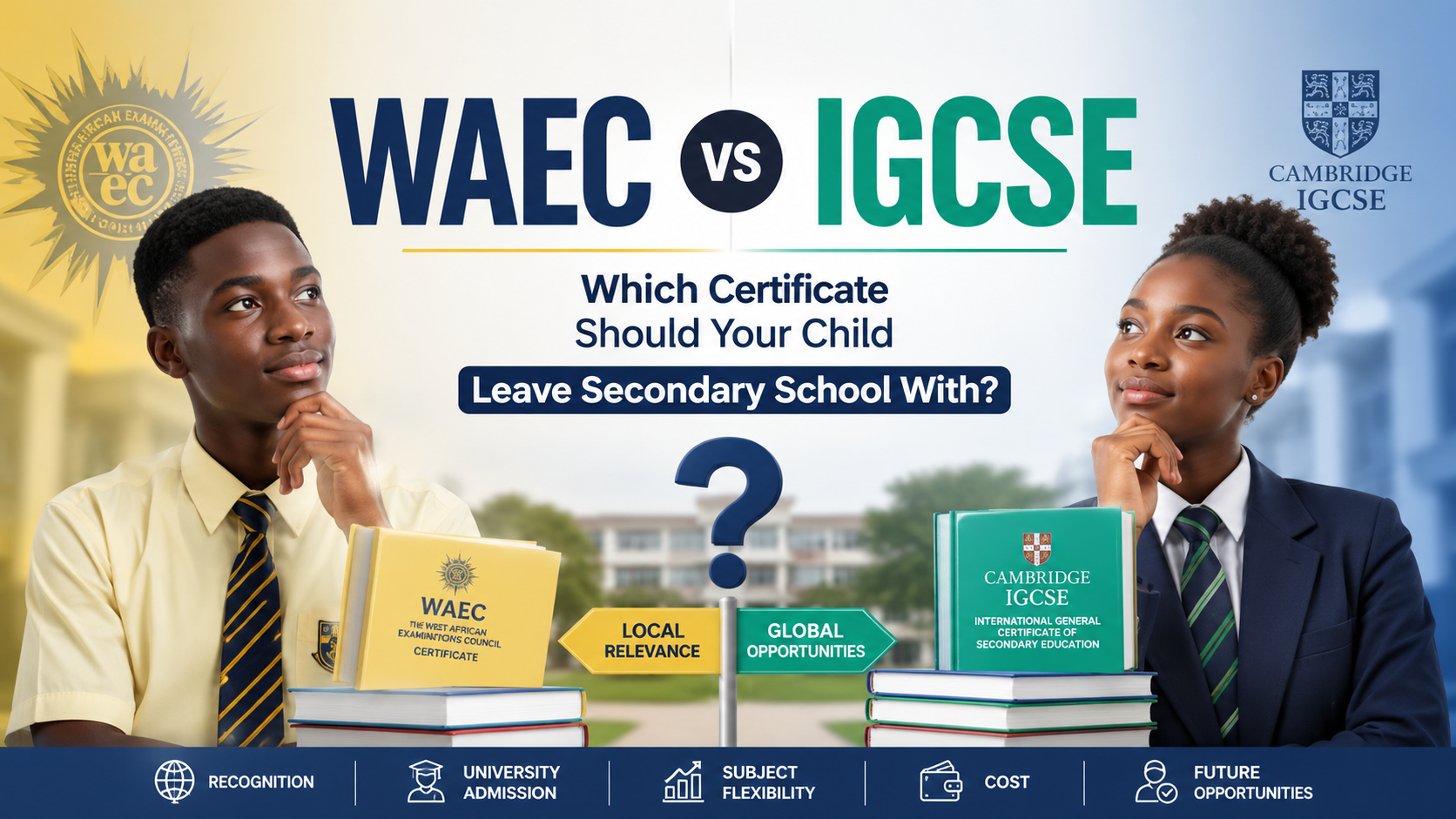
Every year, thousands of Nigerian parents face the same question at the start of secondary school. WAEC or IGCSE? Which one opens more doors? Which one do universities actually respect? And is it possible to do both without overwhelming a child?
The confusion is understandable. Both qualifications cover similar ground: English, Mathematics, Sciences, Humanities, but they come from different examining bodies, carry different weight in different countries, and signal different things to different admissions offices. Getting this wrong at JSS1 can close doors that don’t reopen.
This article gives you a plain, factual answer to every question parents ask about these two qualifications, so you can make the decision with full information.
What is WAEC?
WAEC stands for the West African Examinations Council. The West African Senior School Certificate Examination (WASSCE) is administered by WAEC at the end of SS3 and is the standard qualification for secondary school completion across English-speaking West Africa: Nigeria, Ghana, Sierra Leone, Liberia, and the Gambia.
In Nigeria, WAEC results are accepted by every single university for undergraduate admission. A student needs a minimum of five credits, which must include English Language and Mathematics, to qualify for JAMB consideration and university entry. Without those five credits, university admission in Nigeria does not happen.
WAEC grades run from A1 (highest) down to F9. Grades A1 through C6 are considered passes. Below C6, students have not met the credit threshold.
WAEC is the non-negotiable baseline for any student who intends to attend a Nigerian university.
What is Cambridge IGCSE?
IGCSE stands for International General Certificate of Secondary Education. It is administered by Cambridge Assessment International Education, a department of the University of Cambridge. The IGCSE is taken at the end of SS3 (or equivalent Year 11) and is recognized by universities in the United Kingdom, United States, Canada, Australia, South Africa, and most other higher education systems worldwide.
The IGCSE grades run from 9 (highest) to 1 (lowest) under the current system, or A* to G under the older system that some Nigerian schools still use. A grade of 4 or above is considered a pass under the current system.
Cambridge IGCSE subjects include English Language, English Literature, Mathematics, Additional Mathematics, Sciences, Business Studies, Economics, History, Geography, Computer Science, Art, and dozens more.
The IGCSE is not a Nigerian government requirement. No Nigerian university currently mandates it for admission. Its value lies in international recognition.
The Direct Comparison: WAEC vs IGCSE
For university admission in Nigeria:
WAEC is what matters. JAMB requires it. Nigerian universities require it. An IGCSE certificate on its own will not get a student into the University of Port Harcourt, UNILAG, or any other Nigerian institution without WAEC results alongside it.
For university admission in the United Kingdom:
Cambridge IGCSE is the standard British secondary qualification. UK universities understand it immediately. WAEC is accepted by many UK institutions but often requires further explanation or conversion. Students applying to UK universities with strong IGCSE results, particularly if they also have A-Level or Cambridge AS results, have a straightforward application path.
For university admission in the United States:
US universities do not typically mandate WAEC or IGCSE specifically. What they look for is evidence of completed secondary education alongside SAT or ACT scores. IGCSE results are well understood by US admissions officers. WAEC results are accepted but less familiar and sometimes require a transcript evaluation service. A student with strong IGCSE grades and a competitive SAT score is a competitive US applicant.
For university admission in Canada:
Both WAEC and IGCSE are accepted by Canadian universities as proof of secondary school completion. Some provinces are more familiar with one than the other. Students applying to competitive programmes benefit from having both.
For university admission in Australia:
IGCSE is well recognized across Australian universities. WAEC is accepted but less common. Students targeting Australian higher education benefit from IGCSE alongside IELTS scores.
Can a Student Take Both WAEC and IGCSE at the Same School?
Yes. A small number of schools in Nigeria run both the Nigerian national curriculum, which leads to WAEC and NECO, and the Cambridge international curriculum, which leads to IGCSE, simultaneously. Students graduate with qualifications from both examining bodies, which gives them maximum flexibility when applying to universities in Nigeria or abroad.
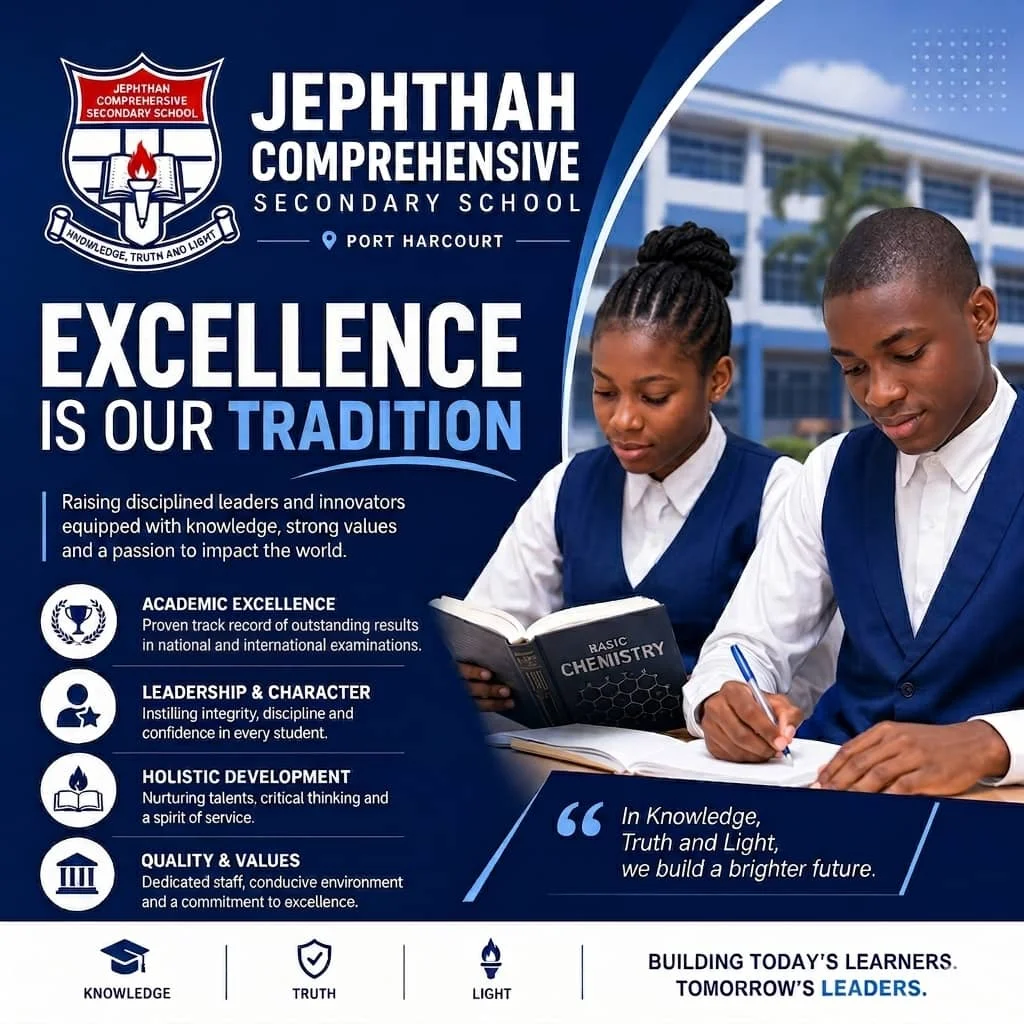
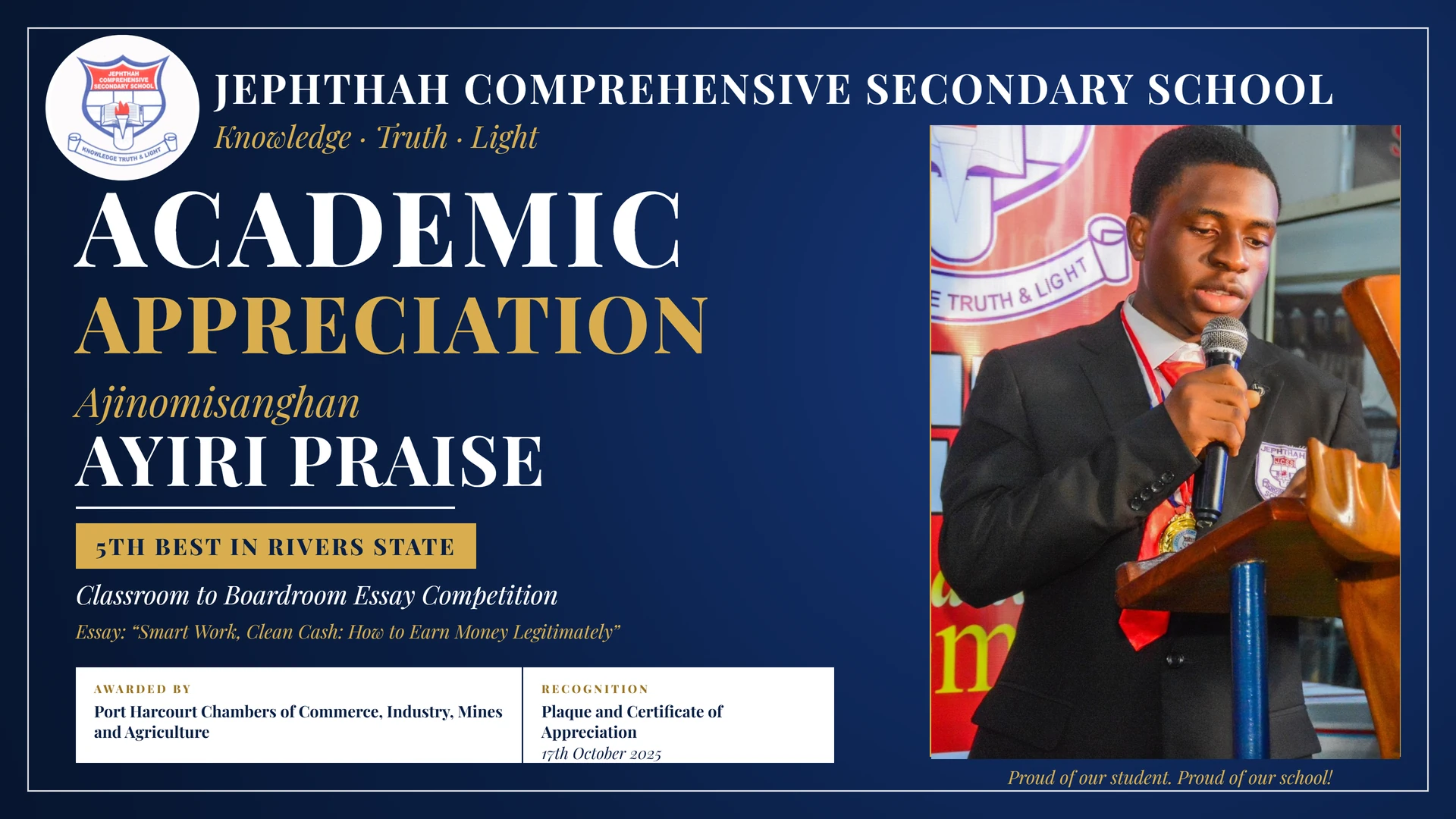
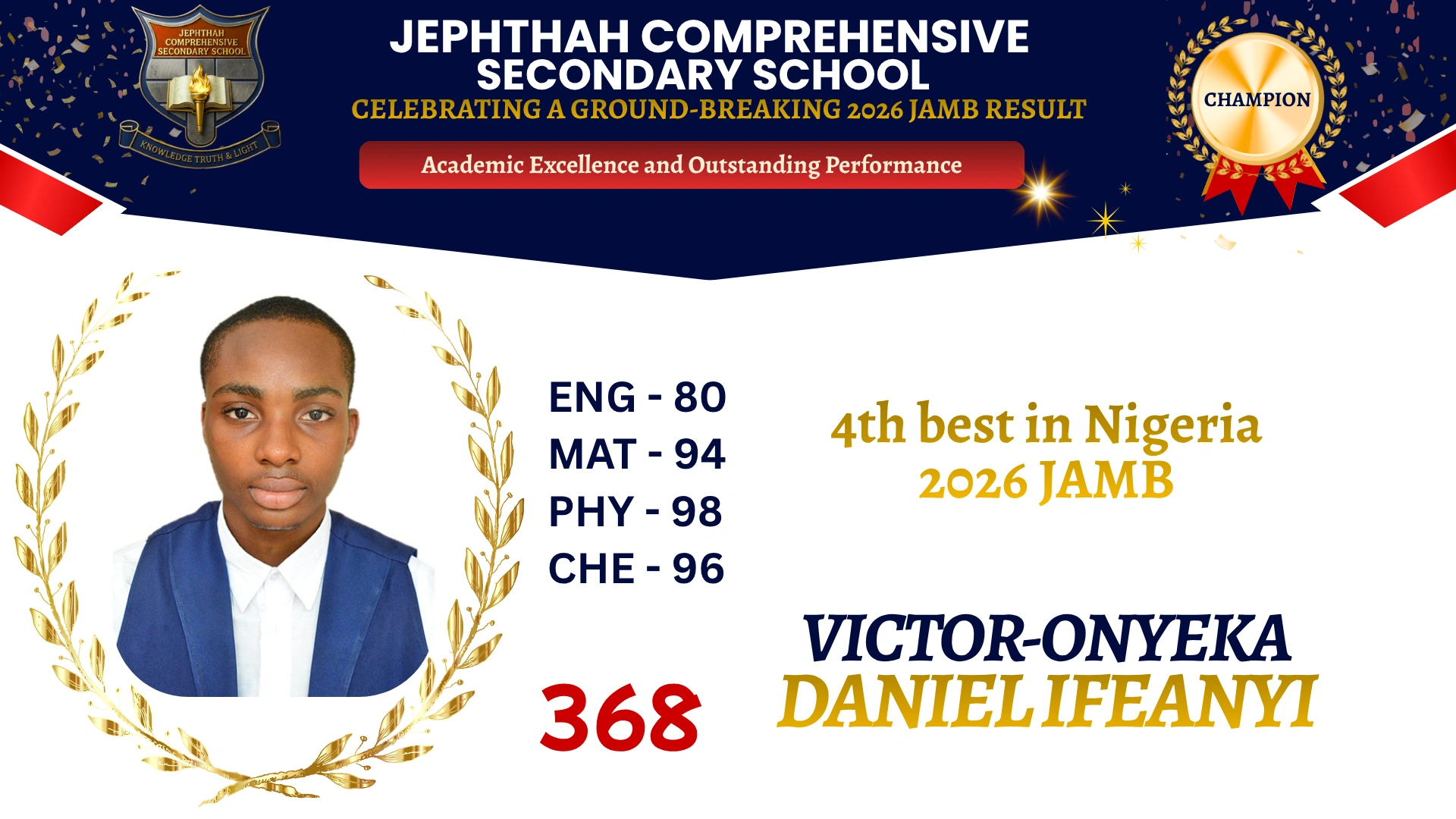
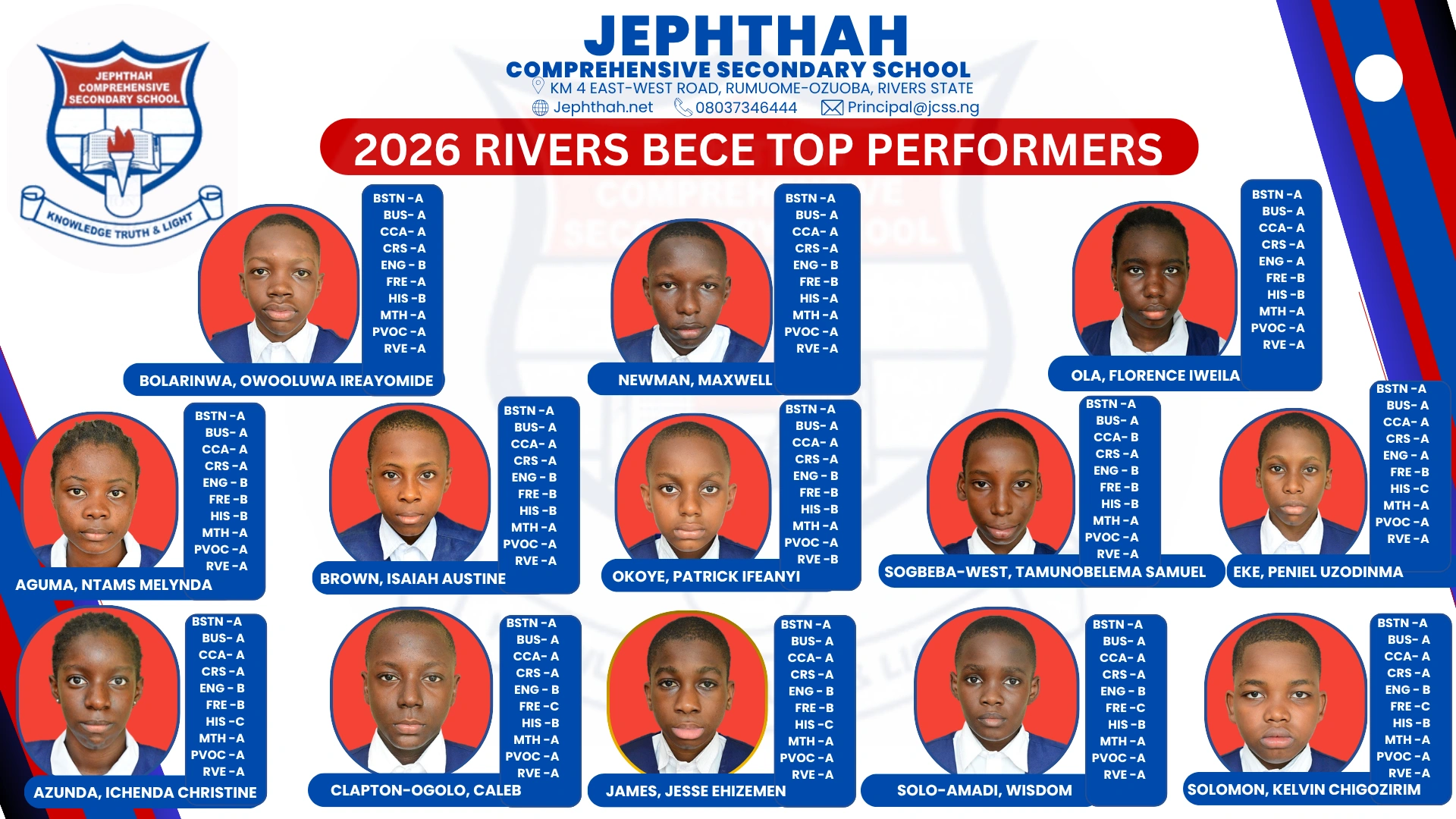
Jephthah Comprehensive Secondary School in Port Harcourt is one of these schools. As an approved Cambridge International Centre and an accredited WAEC examination centre in Rivers State, Jephthah students sit both sets of examinations on the same campus without needing to transfer to another school or register at an external centre.
What Most Parents Get Wrong About IGCSE
Myth 1: IGCSE is harder than WAEC
The difficulty level is comparable. Cambridge IGCSE emphasises analytical thinking and application over rote memorisation, which is a different kind of challenge from WAEC. Students who learn to think critically for IGCSE typically find WAEC preparation easier, not harder.
Myth 2: Doing IGCSE means giving up WAEC
At schools running dual curricula, this is simply not true. The Nigerian national syllabus remains the foundation. IGCSE is an additional qualification layer, not a replacement.
Myth 3: IGCSE is only for children going abroad
This is the most common misconception. Even for students planning to attend Nigerian universities, an IGCSE certificate on their transcript signals critical thinking ability, international academic exposure, and a higher standard of preparation to any employer or postgraduate institution they encounter later in life.
Myth 4: IGCSE results do not matter for Nigerian university admission
Correct. IGCSE alone is not sufficient. But a student who has both WAEC and IGCSE is more qualified than one who has only WAEC, by any measure that counts beyond JSS1.
The Honest Answer for Port Harcourt Parents
If your child is certain they will attend a Nigerian university and never leave the country, WAEC preparation is what the school year should centre on.
If there is any possibility your child will pursue a university education abroad, or if you want to leave that door open, then IGCSE alongside WAEC is the right answer. You get the Nigerian qualification that satisfies JAMB requirements and the international qualification that satisfies UK, US, Canadian, and Australian admissions offices.
The schools in Port Harcourt that offer both give students something that most of their peers in the city will not have: a genuinely open university application.
Frequently Asked Questions on WAEC vs IGCSE
Is IGCSE accepted by Nigerian universities for admission?
Not on its own. Nigerian universities require WASSCE (WAEC) results for admission through JAMB. IGCSE is an additional international qualification and does not replace the WAEC requirement for domestic university entry.
Which is more difficult, WAEC or IGCSE?
They test different skills. WAEC focuses more on syllabus recall. IGCSE places greater emphasis on analysis, interpretation, and written argumentation. Students who prepare for both become stronger in both areas.
Can a student sit Cambridge IGCSE in Port Harcourt?
Yes. Jephthah Comprehensive Secondary School, located at Km4 East-West Road, Rumuome-Ozuoba, Port Harcourt, is an approved and secure Cambridge International Centre in Rivers State. SS3 students sit Cambridge IGCSE at the school. JSS3 students sit the Cambridge Checkpoint Examination on the same campus.
Does doing IGCSE affect a student’s WAEC preparation?
At schools with a dual curriculum, no. The Nigerian national syllabus is taught in full, including WAEC and NECO preparation. IGCSE content is an additional layer, not a replacement for the national curriculum.
What grade do Nigerian students need in IGCSE for UK university admission?
Most UK universities require a minimum of five IGCSEs at grade C or above (grade 4 or above under the current numerical system), including English Language and Mathematics. Competitive universities typically expect higher grades, particularly in relevant subjects.
What SAT score do Nigerian students need alongside IGCSE for US scholarships?
Research consistently shows that Nigerian students with SAT scores above 1400 qualify for merit-based scholarships at US institutions. A strong SAT combined with IGCSE results makes a highly competitive American university application.
The Takeaway
WAEC secures your child’s place in a Nigerian university. Cambridge IGCSE secures their place everywhere else. For parents who want to give their child every option, rather than close any of them at SS3, a school that offers both is not a luxury. It is the most practical academic investment available in Port Harcourt today.
Jephthah Comprehensive Secondary School is an approved Cambridge International Centre and WAEC and NECO examination centre located at Km4, East-West Road, Rumuome-Ozuoba, Port Harcourt, Rivers State. Students sit WAEC, NECO, Cambridge IGCSE, SAT, PSAT, ACT, and IELTS on the same campus. To enquire about admission, visit jephthah.net or call +234 806 261 5330.